
Decoding 2035
Updated: Jul 8
10 Biotech Developments in 2025 For Defining the Next Decade
Can you hear that? It’s the footsteps of BioRevolution!
The year 2025 serves as a definitive historical marker, representing the point at which the silos between biological inquiry and computational engineering have finally collapsed. The next few years are an opportunity for entering the biotech world early. After that, we will start to talk about higher entrance investments. If you read this article, it’s a good signal for you because that means you still have a bit of time. Total investments in biotech ventures surged from $483 billion in 2024 to $546 billion by 2025, representing an impressive 13% CAGR. (...)
After the boom and subsequent downturn of 2021, 2025 can be considered a crucial year for recovery and stabilization in the biotechnology world. We had the chance to see the effects of this in Capital Cell as well. Daniel wrote in his blog in September 2025: "Big pharma has been able to snap up some biotechs with promising preliminary data at reasonable prices: the first quarter of 2025 saw the highest volume of startup acquisitions since 2021 ($71 billion), and 2024 saw the highest number of acquisitions since 2020. A survey at the end of 2024 revealed that nearly two-thirds of venture capital fund managers expected the exit climate to improve in 2025, a big leap in optimism from the previous year."
In this blog, you will find an exhaustive analysis of the ten primary developments of 2025 and their profound implications for the 2035 biotech vision.
1. Baby KJ - The first infant in the world successfully treated with a CRISPR gene-editing therapy
A child diagnosed with a rare genetic disorder has been successfully treated with personalized CRISPR gene editing therapy developed by a team at Children's Hospital of Philadelphia (CHOP) and Penn Medicine. Little KJ was born with a severe deficiency of carbamoyl phosphate synthetase 1 (CPS1), a rare metabolic disease. In just six months, the CHOP/Penn Medicine team and their collaborators rapidly designed and tested a base editor to correct a defective copy of the CPS1 gene. Following safety testing in laboratory animals, they obtained regulatory approval to infuse lipid nanoparticles (which carry messenger RNA with the gene editing tools) into the bloodstream of the patient, who was then nearly seven months old. After 307 days in the hospital, KJ was discharged in mid-2025 and has since continued to make successful progress at home. (...)
Ahrens-Nicklas and Kiran Musunuru began collaborating in 2023 to explore the feasibility of customized gene-editing therapies for individual patients, building on years of work in rare metabolic disorders and therapeutic gene editing. As co-corresponding authors and members of the NIH-funded Somatic Cell Genome Editing Consortium, their work reflects a broader shift toward collaborative science. This aligns with the idea I discussed in my blog "The Decade of Coopetition": today’s biology-driven challenges are too complex for any single actor to solve alone and demand thousands of perspectives converging on shared outcomes.
By 2035, these refinements will allow for the treatment of polygenic chronic diseases, moving beyond rare monogenic disorders to tackle cardiovascular disease, diabetes, and even the genetic drivers of neurodegeneration. This is also the clinical proof of concept for personalized medicine in 2035. The days when we will rapidly move away from the "one-size-fits-all" approach in healthcare are ahead of us.
2. The Commercialization of Organoid Intelligence and Biological Computing
The emergence of "Organoid Intelligence" (OI) as a commercially viable sector in 2025 represents perhaps the most radical departure from traditional silicon-based computing. Laboratory milestones have transitioned from demonstrating that neurons can play basic video games to the deployment of integrated, "wetware-as-a-service" platforms. The primary breakthrough of 2025 is the commercial launch of the CL1 system by Cortical Labs, which signifies the world’s first "Synthetic Biological Intelligence" (SBI) platform. (...)
The technical architecture of the CL1 system involves combining lab-grown human neurons with silicon chips, thereby creating fluid neural networks capable of learning and adapting faster than traditional silicon-based architectures for specific tasks such as pattern recognition and real-time environmental navigation. If you want to learn more about it, you can read Elif Damla Karakolcu's full article on Organoid Intelligence.
<< English subtitles are available. >>
By 2035, this trajectory suggests a world where the energy limitations of artificial intelligence are circumvented through "bio-autonomous systems". We anticipate the maturation of hybrid bio-digital ecosystems where biological processors handle complex, context-aware decision-making while silicon-based systems manage high-speed data storage and retrieval. This dual-track computing will be essential for managing the petabytes of genomic and environmental data that will define personal health monitoring by the mid-2030s.
3. The Announcement of the Synthetic Human Genome Project (SynHG)
In June 2025, the announcement of the Synthetic Human Genome Project (SynHG) in the United Kingdom marked the most ambitious expansion of synthetic biology to date. Funded with £10 million from the Wellcome Trust, SynHG aims to move from editing specific genes to writing entire chromosomes from scratch. (...)
The 2035 vision for synthetic genomics is the creation of "Designer Cell Therapies" and "Virus-Resistant Tissues" for transplantation. By synthesizing genomes with altered genetic codes, researchers can create cells that are immune to viral infection or immune system rejection. This has profound implications for global health security and the organ transplant crisis.
“We are leveraging cutting-edge generative AI and advanced robotic assembly technologies to revolutionize synthetic mammalian chromosome engineering. Our innovative approach aims to develop transformative solutions for the pressing societal challenges of our time, creating a more sustainable and healthier future for all."
· Professor Yizhi (Patrick) Cai, Chair Professor of Synthetic Genomics at The University of Manchester
Additionally, the year 2025 marked a watershed moment for synthetic life with the announcement by Macquarie University that researchers had completed the synthesis of all 16 chromosomes of the yeast Saccharomyces cerevisiae (Sc2.0). This is the first time a full synthetic eukaryotic genome has been constructed, providing a definitive proof-of-concept for the synthesis of more complex organisms like food crops and medicinal plants. The laboratory process involved more than a decade of work, culminating in the synthesis of the final chromosome, SynXVI. (...)
4. High-Fidelity Vascularized Organoids: Overcoming the Diffusion Limit
For decades, the utility of lab-grown organoids was limited by their lack of a vascular system, which prevented them from growing beyond a few millimeters and reaching functional maturity. In 2025, a Stanford University research team led by Dr. Joseph C. Wu and Dr. Oscar Abilez published a landmark study in Science detailing the successful creation of vascularized heart and liver organoids. These organoids developed branching, tubular vessels ranging from 10 to 100 microns in diameter, effectively recapitulating the capillary networks of a six-week-old human embryonic heart. Furthermore, the team engineered a "triple reporter stem cell line" that allows for the real-time fluorescent visualization of heart cells and blood vessel cells as they intermix during development. (...) If you want to know more about organoids, you can read my article on the subject here.

This two-week-old heart organoid—with cardiomyocytes (green) and smooth muscle cells (white)—is surrounded by endothelial cells (magenta) that form a network of realistic blood vessels. | Courtesy Stanford Medicine
By 2035, this technology is expected to bridge the gap between in vitro models and clinical transplantation. The ability to grow vascularized human tissue at scale will allow for "organoid-based regenerative therapies," where patients with heart failure or liver disease receive lab-grown, vascularized tissue patches that integrate seamlessly with their own circulatory systems. This represents the physical transformation of healthcare from symptom management to organ repair.
5. The Industrialization of Generative Biology and AI Factories
Corporate initiatives in 2025 have shifted toward the creation of massive "AI factories" dedicated to drug discovery and molecular design. The most prominent example is Eli Lilly and Company’s deployment of the world’s largest pharmaceutical AI factory, powered by 1,016 NVIDIA Blackwell Ultra GPUs. This facility, which utilizes the DGX SuperPOD architecture, is designed to train large-scale biomedical foundation models capable of uncovering new atomic configurations and motifs for drug development. The efficiency gains are significant: processing genomic sequences that once took months can now be completed in days. (...)

By 2035, we can foresee a future in which the traditional, linear R&D model, where bringing a drug to market takes 10 to 15 years, is replaced by networked innovation ecosystems that design, test, and validate new therapies in near real time. By 2035, generative biology tools may enable in silico simulation of interactions between drugs and human digital twins, dramatically reducing the need for large-scale, time-consuming human trials at every stage of regulatory approval.
6. Bio-Digital Convergence and Brain-Computer Interface Maturation
The laboratory-driven progress in brain-machine interfaces (BMIs) has moved beyond proof-of-concept into the "interface maturation stage" in 2025. Neuralink’s clinical trials have demonstrated that patients with paralysis can control digital devices and robotic arms with high-bandwidth, minimally invasive implants. In 2025, patients like "Alex" and "Brad" have used these interfaces to regain autonomy in writing and creative work. (...)
Furthermore, companies like Synchron have pioneered endovascular BMIs that do not require open-brain surgery, instead delivering electrodes via the blood vessels. These developments are supported by a 2025 BCI market that is rapidly expanding toward a "human-AI symbiosis" goal.
By 2035, the biodigital revolution envisions "distributed biological networks" where biocompatible nanosystems coordinate activities across organ systems and interface directly with neural pathways. This will not only restore function to those with disabilities but also enable new dimensions of human capability, such as the direct digital-to-neural transfer of information or the real-time monitoring of mental health biomarkers.
7. Space-Based Biomanufacturing and the ISS Research Milestones
In November 2025, the International Space Station (ISS) reached a milestone of 25 years of continuous human presence, marked by a surge in "out of this world" biological discoveries. A primary achievement was the successful 3D printing of eight medical implants for peripheral nerve repair in microgravity. The absence of gravity prevents particle settling, allowing for the creation of more uniform and stable structures than are possible on Earth. (...)
Additionally, protein crystal growth experiments on the ISS informed the development of a newly FDA-approved injectable cancer medication. This research yielded critical insights into the particle size needed for high-efficiency drug delivery, promising to lower costs and treatment times for patients. (...)

ESA (European Space Agency) astronaut Thomas Pesquet conducts research aboard the International Space Station supporting the advancement of cancer therapeutics.
By 2035, microgravity research can become a cornerstone of drug discovery, as "space-born" insights into aging and cellular stress provide new targets for longevity therapies on Earth.
8. The Longevity Revolution and Cellular Reprogramming
The 2025 Breakthrough Prize in Life Sciences honored discoveries in GLP-1 drugs and DNA editing, signaling a mainstream shift toward longevity and metabolic health as the new frontiers of medicine. Researchers are now focusing on "cell reset buttons" that can turn back the biological clock and remove "zombie" (senescent) cells that contribute to aging. (...)
Companies like BioAge Labs are using AI and protein profiling from Norway’s HUNT Biobank to link molecular changes with the shift from middle-age health to cardiometabolic disease, cognitive decline, and other chronic conditions, paving the way for therapies that intervene before illness takes hold. (...)
By 2035, the vision is one of "Health Lifespan Extension," where medicine focuses on maintaining homeostasis and preventing the "deviations" that lead to disease. We can anticipate a 2035 world where the concept of "aging" is redefined not as an inevitability, but as a treatable condition managed through a combination of periodic cellular resets and continuous, AI-driven monitoring.
9. Spatial Proteomics and the Multi-Omics Tissue Atlas
A critical bottleneck in biotechnology has been the "Spatial Blindness" of traditional omics, which grinds tissue samples into a "biological smoothie," losing the vital context of cellular interactions. The 2025 reference surge in "Spatial Proteomics" and "Spatial Transcriptomics" signals the end of this era. By mapping the location and abundance of proteins and RNA transcripts within their original tissue context, researchers can finally understand the "architecture of disease". Technologies such as Digital Spatial Profiling (DSP) have seen an increase in citations annually. The primary driver is oncology, specifically the need to understand why certain patients respond to immunotherapy while others do not. (…)
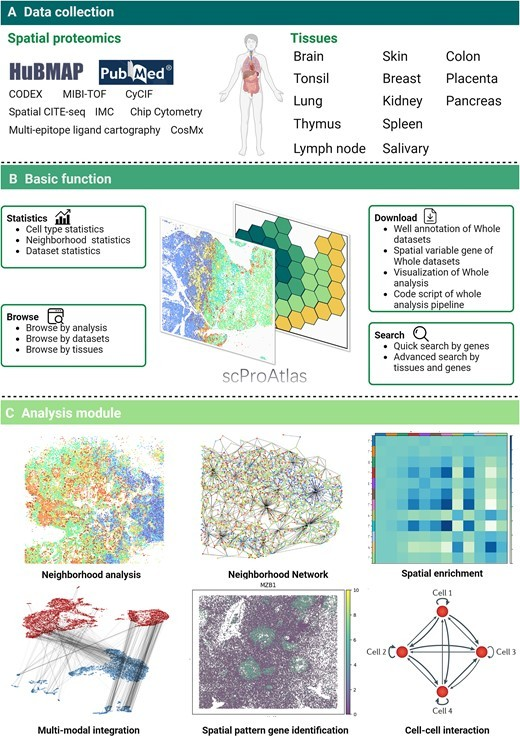
Overview of scProAtlas. (A). Public resources and tissues used in scProAtlas. (B). Basic function of scProAtlas. scProAtlas supports browsing, downloading, and searching. (C). Analysis module in scProAtlas.
The 2035 implication of this data is the creation of a "Human Cellular Atlas,"a digital twin of human tissues that researchers can use to test drugs in silico. By combining spatial proteomics with organ-on-a-chip technology, the industry will be able to model the complex tumor microenvironment with high fidelity. This will allow for the development of "Spatial Vaccines" and "Localized Immunotherapy," where treatments are designed to navigate the specific physical barriers of a patient's tumor. You can read my article on Digital Twins in Healthcare.
10. Multi-Specific ADCs and Targeted Degraders
Antibody-drug conjugates (ADCs) have evolved from simple toxins attached to antibodies into sophisticated platforms like "multi-payload" ADCs and "antibody-degrader" conjugates (DACs). These systems are designed to deliver multiple therapeutic agents simultaneously, bypassing the resistance mechanisms that plague traditional chemotherapy.
Solve Therapeutics and Tubulis were among the most highly-funded companies in late 2025, raising $120 million and $361 million, respectively, to advance ADC pipelines. (...) (...)
The 2035 vision for these modalities is the definitive management of solid tumors. By 2035, the standard treatment for metastatic cancer can likely be a "Logic-Gated" ADC that only releases its payload when it detects two or more specific tumor markers, virtually eliminating the systemic side effects that define current oncology.
Sometimes in big labs. Sometimes in small labs. Sometimes by startups or big pharma companies. Often in silence for daily life, but echoing loudly in the scientific world. That is what is happening: The BioRevolution. For the past ten years, we said it was coming. In 2025, we are no longer waiting for it because now, we are inside it.
While writing this article, I found myself proud of my colleagues and of Capital Cell once again. Many of the topics explored here are already part of our blogs, articles, videos, and campaigns. That repetition is not a coincidence. It is a signal. It tells us we are positioned where the future is forming.
Biotech rarely looks fast from within the scientific process. Progress accumulates quietly, over many years, long before markets begin to notice.
What the market calls a “breakthrough” is usually the final visible step of a journey that started ten to fifteen years earlier.
The strategic implication is clear: Scientific journals function as early indicators of future company formation. Sustained citation growth around a gene-editing pathway in 2020 can translate into venture creation in the late 2020s and public market relevance in the early 2030s.
Much of what will define biotech markets in 2035 is already written in papers published today. So the future is already written.
In this blog, we revisited together the scientific archives of 2025 to identify which discoveries are most likely to shape the market a decade from now.

This infographic was designed using NotebookLM, based on Elif Damla Karakolcu’s blog on “Decoding 2035: 10 Biotech Developments in 2025 For Defining the Next Decade.”


